
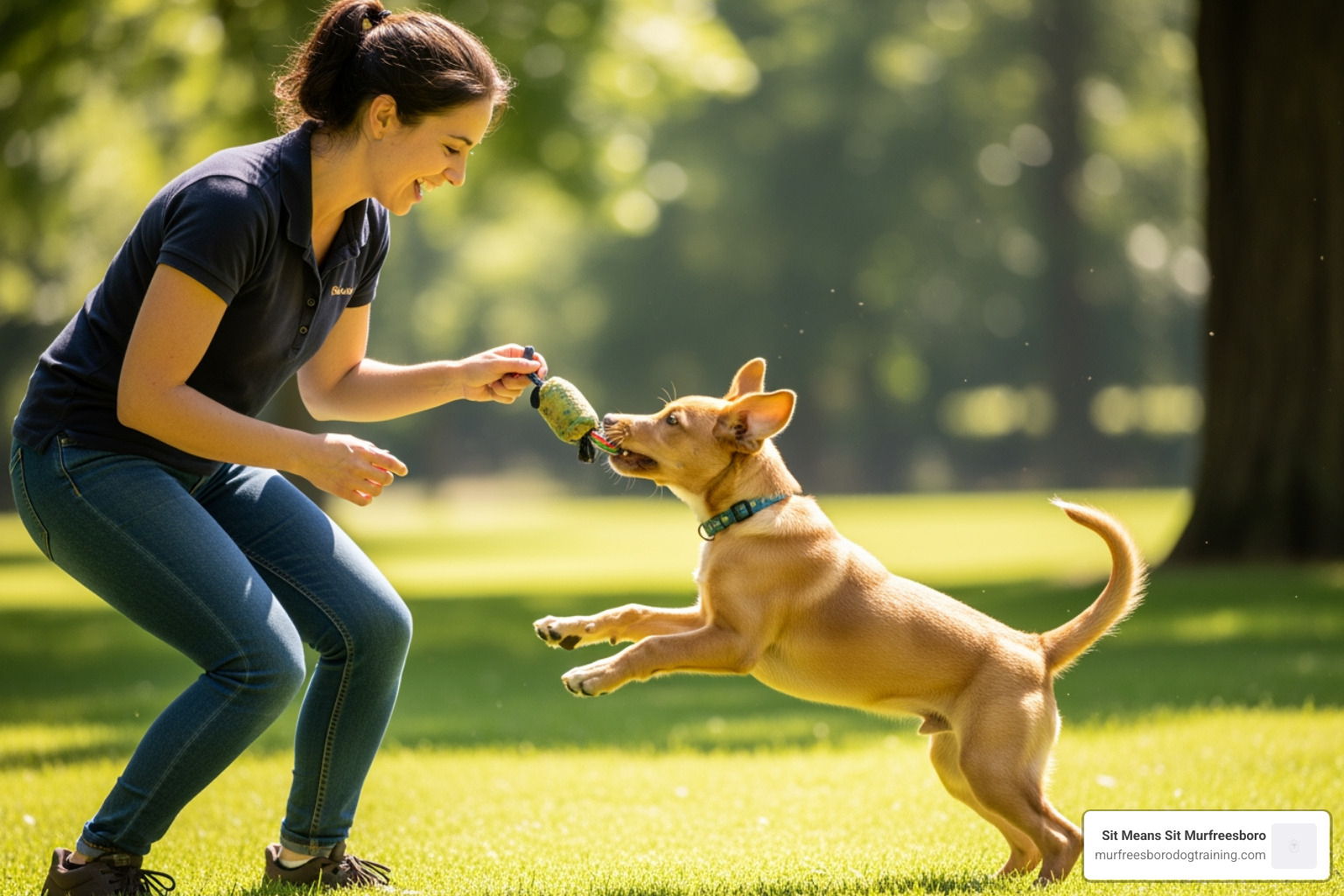
Why Making Training Enjoyable Sets Your Puppy Up for Success
Fun puppy training transforms the often frustrating process of teaching basic obedience into an engaging activity that both you and your puppy will look forward to. Here’s what makes training fun and effective:
- Use games like Hide and Seek, Muffin Tin Puzzles, and Fetch to teach recall, problem-solving, and impulse control
- Keep sessions short (5-15 minutes) to maintain your puppy’s focus and prevent boredom
- Incorporate play into everyday training to build confidence, burn energy, and strengthen your bond
- Mix mental and physical activities to tire out your puppy more effectively than exercise alone
- Reward good behavior with treats, praise, and play to make learning feel like a game
Are you having a rough time engaging your puppy during training? You’re not alone. Many dog owners struggle with puppies that seem uninterested, distracted, or too energetic to focus. The problem often isn’t your training skills or an “untrainable” puppy—you’re just missing a key element: fun.
Research shows that gamifying your training sessions will improve your puppy’s participation and response while building a stronger bond between you two. When dogs are having fun, they learn faster. Games will set you and your puppy up for a lifetime of success by teaching them that learning is enjoyable and rewarding.
Traditional training can feel like a chore for both you and your puppy. Repeating the same commands over and over while your puppy loses interest creates frustration on both ends. But when you turn training into play, everything changes. Your puppy stays engaged longer, retains information better, and actually wants to participate.
The science backs this up. Playing games will mentally and physically exhaust your puppy in a good way. Mental stimulation can be just as tiring as physical exercise—sometimes even more so. A tired puppy is a well-behaved puppy, and a puppy who’s learned through play is one who’ll remember those lessons for life.
Games also provide crucial benefits beyond basic obedience. They help with memory and problem-solving, curtail destructive behaviors by keeping your puppy entertained, and build confidence for handling new situations. For a healthy, confident, and socialized puppy, it’s important to provide both physical exercise and mental stimulation through enjoyable activities.
The best part? It’s never too late to start. Dogs of all ages can learn new tricks and benefit from play-based training. Whether you have an 8-week-old puppy or a teenager going through their rebellious phase, incorporating fun into training sessions will make the process more enjoyable and effective.
I’m Stephen Sovenyhazy, and while my background is primarily in digital marketing and platform engineering, I’ve researched extensively how engagement and gamification principles apply across different fields—including fun puppy training methods that keep learners motivated and eager to participate. The same principles that make digital experiences engaging work remarkably well in dog training too.
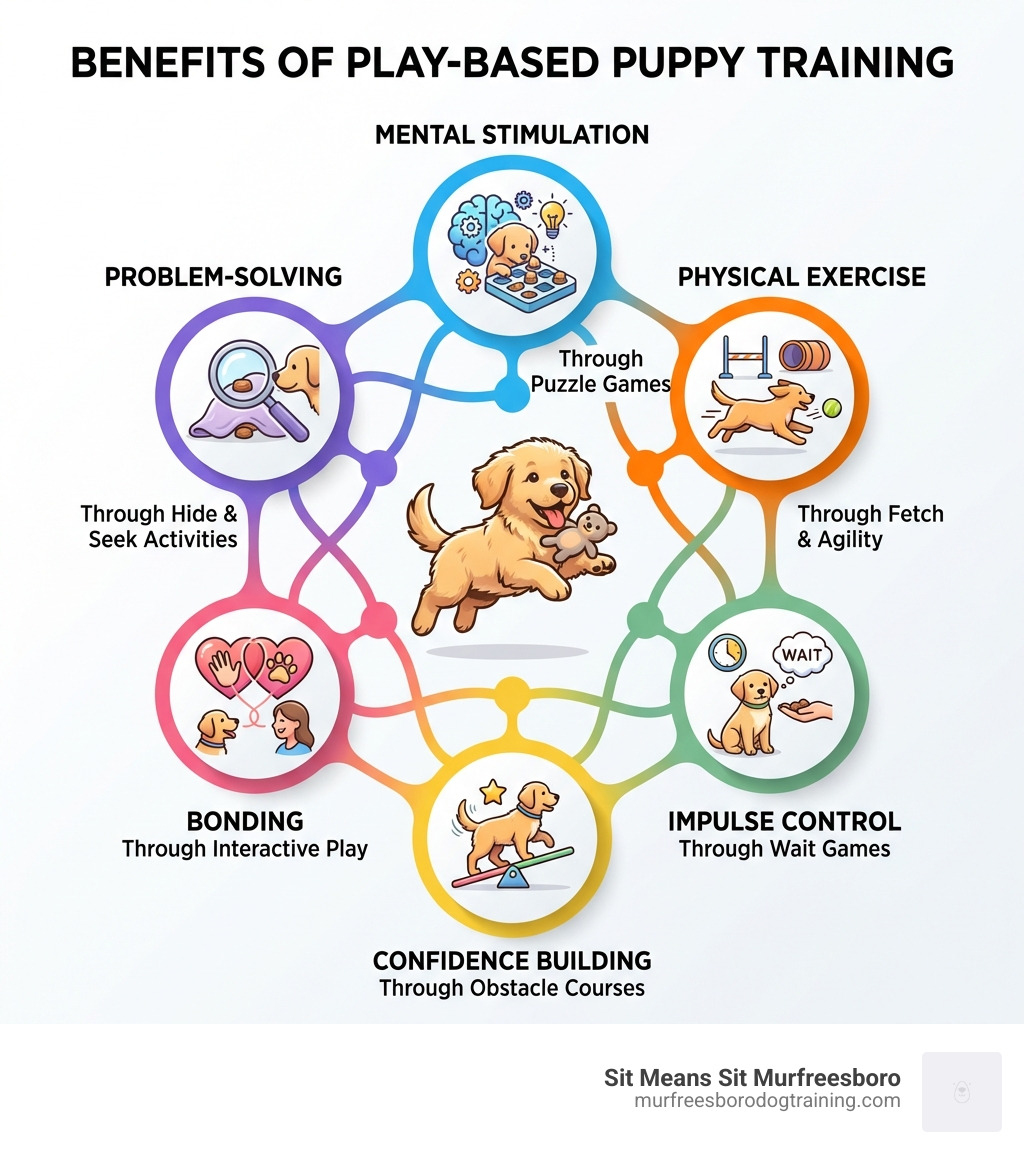
Why Fun Puppy Training is Essential for Development
At Sit Means Sit Murfreesboro, we believe that fun puppy training is the cornerstone of a well-adjusted adult dog. It isn’t just about “tricks”; it’s about holistic development. When we engage a puppy’s mind through play, we are essentially building the neural pathways they will use for the rest of their lives.
Mental stimulation is just as important as physical exercise. In fact, a bored puppy is often a destructive puppy. If they don’t have a “job” or a game to play, they will invent their own—usually involving your favorite pair of shoes or the corners of your drywall. By providing structured play, we meet their instinctive needs, such as sniffing, chasing, and problem-solving. This cognitive development assists with memory and hones their ability to focus despite distractions.
Furthermore, the average dog can learn more than 150 words, and super-smart pups can learn over 200! By turning training into a game, we expand their vocabulary and their confidence. Each time a puppy “solves” a puzzle or successfully steers a new challenge, their confidence grows. This reduces stress and anxiety, creating a dog that is comfortable in its own skin and ready to face the world in Middle Tennessee.
The Benefits of Fun Puppy Training for Bonding
The relationship you have with your puppy is built on trust and shared experiences. Gamifying your training sessions improves your pooch’s participation and response because they aren’t working out of obligation—they’re working for the joy of the game. This creates a much higher response rate than traditional, repetitive drilling.
When you play together, you become the most exciting thing in your puppy’s world. This bond is what makes them want to listen to you when you’re out at a park in Smyrna or walking through Murfreesboro. It transforms you from a “cookie dispenser” into a partner. For those looking to dive deeper into building this relationship, you can find more info about training programs that prioritize this connection.
Adapting Fun Puppy Training for Different Energy Levels
Not every puppy is a high-octane athlete. A sleepy Basset Hound puppy has different needs than a wired Border Collie. We must consider the puppy’s age, health, and breed-specific instincts.
- Young Puppies (8-12 weeks): Focus on very short sessions (3-5 minutes) and low-impact games. Their growth plates are still closing, so avoid jumping or sharp turns.
- High-Energy Breeds: These pups need “jobs.” Agility-based games and intense scent work can help burn off that “zoomie” energy.
- Low-Energy or Shy Pups: Use gentle games like “Which Hand?” to build confidence without overstimulating them.
Always monitor for signs of exhaustion or overstimulation. If your puppy starts nipping or stops listening, it’s time for a nap, not more play!
Engaging Indoor Games for Fun Puppy Training
Rainy days in Rutherford County don’t have to mean a day without progress. Indoor fun puppy training is incredibly effective because it happens in a low-distraction environment.
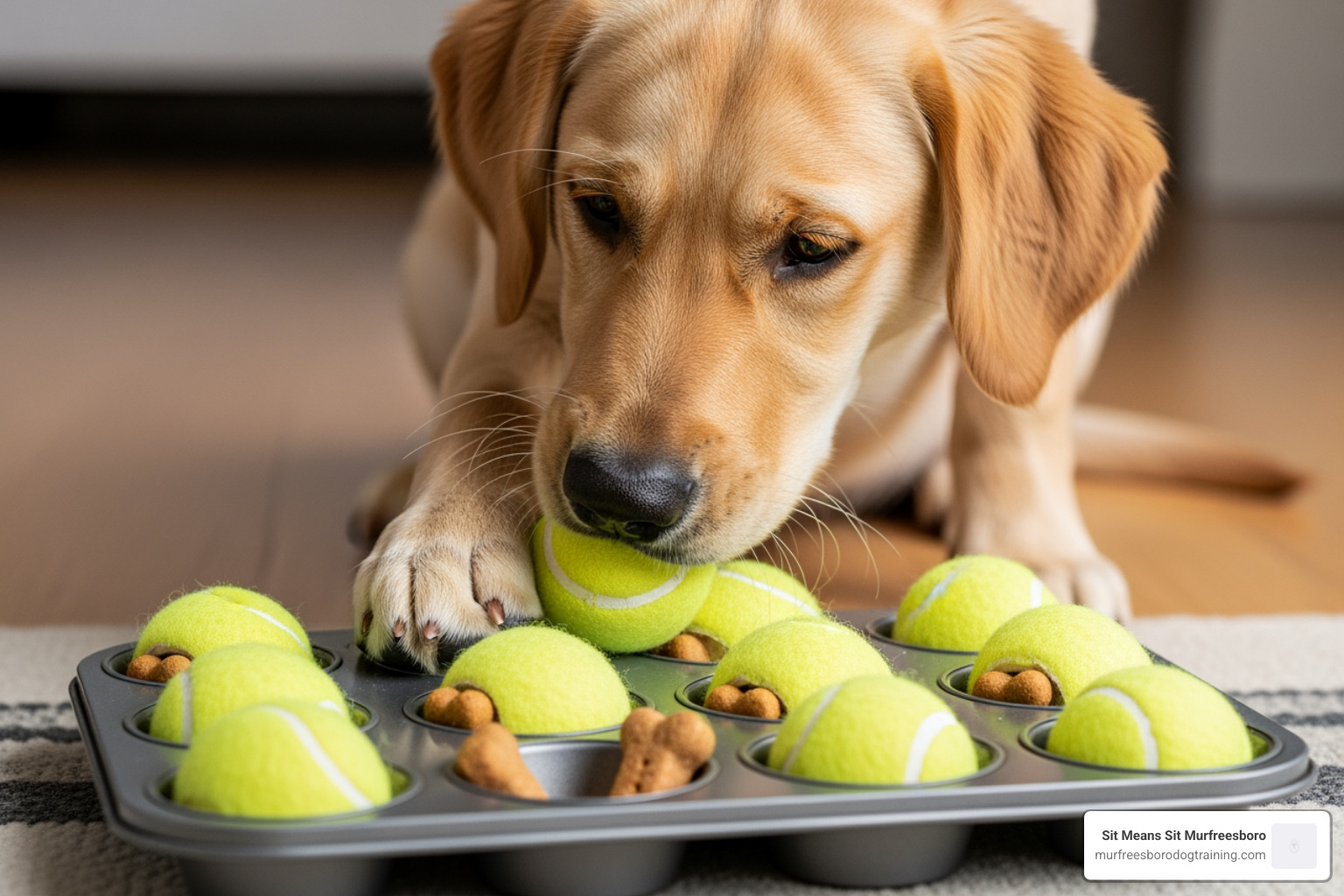
Brain Games for Mental Enrichment
One of our favorite DIY games is the Muffin Tin Puzzle. Simply place treats in the cups of a muffin tin and cover them with tennis balls. Your puppy has to figure out how to move the balls to get the reward. If they are more interested in the balls, you can try the cups game, hiding a treat under one of three cups and shuffling them.
Another great exercise is The “Which Hand?” game. This teaches them to use their nose and focus. Simply hide a treat in one fist and let them sniff it out. These games aren’t just fun; they are vocabulary-building exercises. You can start naming their toys—”Find the Bear” or “Get the Ball”—to further expand their cognitive skills.
Teaching Basic Obedience Indoors
You can teach almost all basic obedience through games. Hide and Seek is an elite way to practice recall (coming when called). Have a family member hold the puppy while you hide in another room with a high-value treat. Call their name and “Come!” When they find you, make it a party!
For leash training, try Red Light Green Light. When the leash is loose, you walk (Green Light). The second the leash goes tight, you stop (Red Light). This teaches them that a loose leash is the key to moving forward. You can also try the Ping-Pong game between two people to make the “Come” command lightning-fast.
Outdoor Adventures and Agility Skills
Once your puppy has the basics down indoors, it’s time to head out into the backyard or a quiet park in Rockvale. Outdoor fun puppy training introduces more distractions, which is essential for real-world reliability.
Games for Leash Training and Recall
Outdoor training should include Adventure Walks. These aren’t structured “heeling” walks. Instead, use a long leash (6-10 feet) and let your puppy sniff and explore. This provides massive mental stimulation.
To work on focus, play Follow Me. Walk in a random pattern and reward your puppy every time they choose to walk by your side. If they get ahead, simply turn and walk the other direction. This makes walking with you a fun game of “Where are we going next?”
Building Coordination with Agility Games
Agility isn’t just for professionals; it’s a great way to build body awareness and confidence in puppies. You don’t need expensive equipment. You can DIY different variations of obstacle courses using household items like chairs to crawl under (tunnels), broomsticks on the ground to walk over (cavalettis), or hula hoops to walk through.
| Feature | Indoor Training | Outdoor Training |
|---|---|---|
| Distraction Level | Low | High |
| Focus Area | New behaviors, focus | Generalization, energy burn |
| Best Games | Muffin Tin, Which Hand? | Fetch, Adventure Walks |
| Safety | Controlled environment | Requires leash/fenced area |
Teaching Impulse Control and Life Skills Through Play
Impulse control is perhaps the most important “life skill” a puppy can learn. At Sit Means Sit Murfreesboro, we use games to teach puppies that waiting for what they want is the fastest way to get it.
- The Elevator Game: Hold your puppy’s food bowl. If they jump or move toward it, the “elevator” goes up (you lift the bowl). When they sit and wait, the elevator goes down. This teaches them to stay still until given permission to eat.
- Wild Sits: Get your puppy really excited—clap your hands, jump around, maybe use a toy. Then, suddenly say “Sit!” The goal is to go from “wild” to “settled” instantly. This is a vital skill for managing hyperactive behavior.
- Hand Zen: Hold a treat in a closed fist. Your puppy will likely lick or paw at your hand. Wait. The second they pull back and wait patiently, open your hand and give the treat.
- Crate Games: Using Crate Games makes the crate a happy place. It teaches them to wait for a release cue rather than bolting out the door the moment it opens.
Overcoming Common Training Challenges
Even with fun puppy training, you’ll hit a few bumps. Here’s how to handle them:
- Mouthy Behavior: Puppies explore with their mouths. If they get too “nippy” during a game of Tug-of-War, the game ends immediately. Redirect them to a chew toy.
- Distractions: If your puppy can’t focus outside in Lascassas, move back to the porch or indoors. You have to build up to distractions slowly.
- Boredom: If your puppy is checking out, your rewards might be too low-value. Switch from kibble to small bits of chicken or a favorite squeaky toy.
- Jumping: Use the “Oops!” game. If they jump to say hello, say “Oops!”, turn your back, and walk away. Interaction only happens when all four paws are on the floor.
If you find yourself stuck, don’t worry. Professional help can bridge the gap. You can check out more info about training programs that help address these specific problems.
Frequently Asked Questions about Puppy Games
What are the best games for puppy recall?
Hide and Seek and the Ping-Pong game are the gold standards. They teach the puppy that “Come” always results in a massive reward and a fun interaction. Always keep it positive—never call your puppy to you to do something they dislike (like a bath or clipping nails) when you are first training this.
How do games help with puppy destructive behavior?
Destructive behavior is usually a symptom of boredom or pent-up energy. Games like “Find the Toy” or using snuffle mats provide mental exhaustion. A puppy who has spent 15 minutes using their brain to find hidden treats is often more tired than a puppy who ran in the yard for an hour.
Can older dogs learn through these training games?
Absolutely! It is a myth that you can’t teach an old dog new tricks. While puppies are in a “critical learning period,” adult and senior dogs still benefit immensely from the dopamine release and mental stimulation that play-based training provides. It keeps their minds sharp and strengthens your lifelong bond.
Conclusion
At Sit Means Sit Murfreesboro, we aren’t just teaching your dog to “sit” and “stay.” Our mission is to transform your puppy into a confident, obedient companion that can handle the real world. By utilizing fun puppy training, we ensure that the learning process is something your dog loves, which leads to much better long-term reliability.
Whether you’re in Murfreesboro, Christiana, or Walterhill, we offer personalized training and ongoing support to address complex behavioral issues and ensure a better life for both you and your furry friend. Ready to take the next step in your puppy’s journey? Find more info about training programs and let’s start making training the highlight of your puppy’s day!