
Why You Should Teach Dog to Settle for Real-World Reliability
Teaching a dog to settle is one of the most practical skills you can build — and it doesn’t have to take weeks of frustrating repetition. Here’s a quick overview of what it involves:
How to teach a dog to settle:
- Start in a calm, low-distraction environment
- Guide your dog into a relaxed down position using leash and body language
- Reward calm, still behavior — not just the position
- Gradually build duration, then add distance
- Proof the behavior in real-world environments with distractions
Most dogs can show meaningful progress within the first week of consistent, handler-led practice.
A lot of dog owners assume an unruly or restless dog just needs more exercise. But the truth is, many dogs never learn how to switch off — not because they can’t, but because no one taught them how.
That gap shows up fast. Your dog can’t sit still at a restaurant patio. They bolt when guests arrive. They pace, nudge, and demand attention the moment you stop moving.
Settling is the skill that fixes this. It’s not just “stay.” It’s a genuine off-switch — a trained calm state your dog can hold in real life, not just in your living room.
I’m Teddy Wall, owner of Murfreesboro Dog Training, and I’ve spent years working with dogs of all temperaments — from high-drive working dogs to everyday family pets — applying the same handler-led principles to teach dog to settle reliably in the real world. Let’s walk through exactly how it’s done.
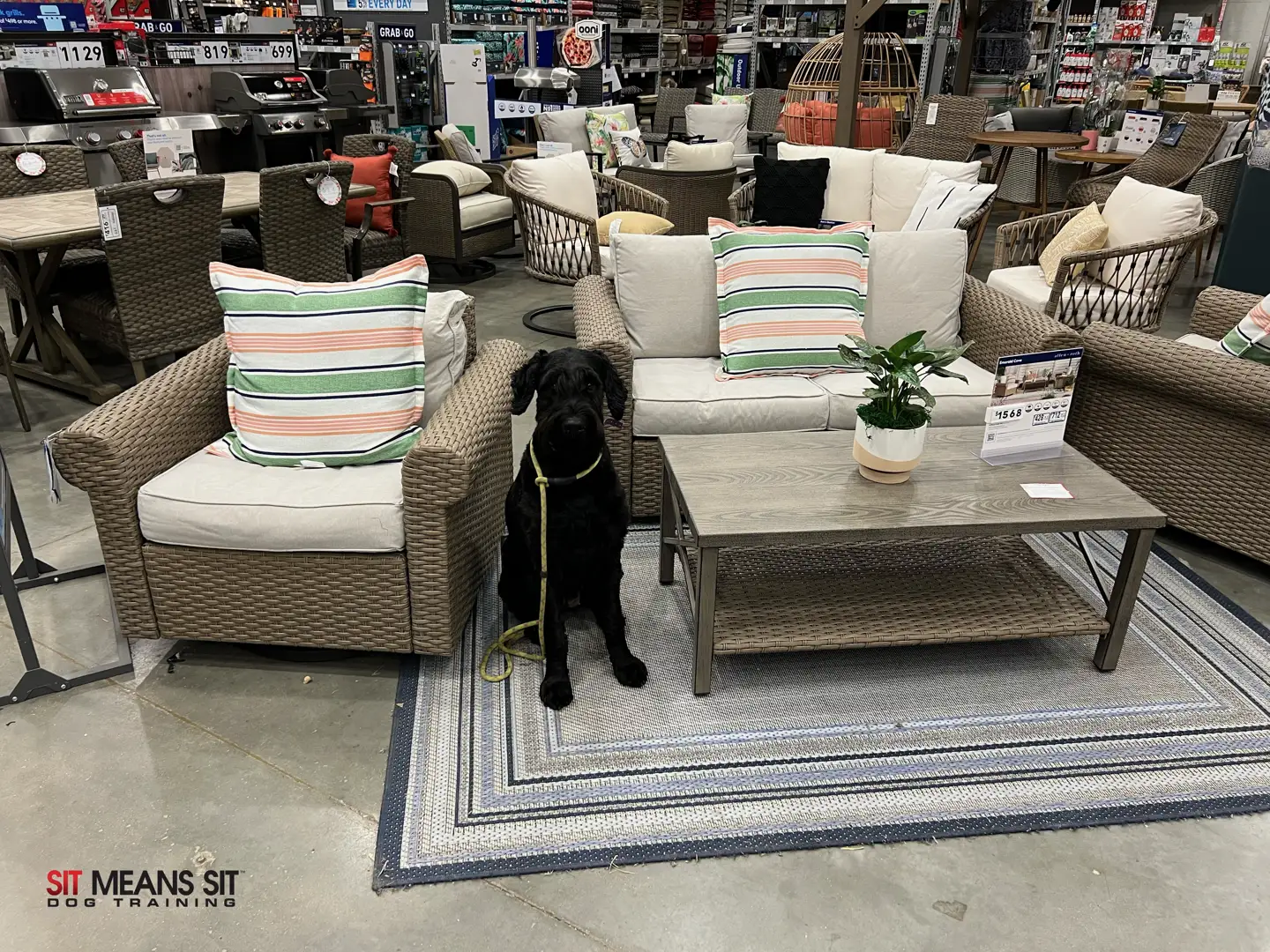
When we talk about dog training in Murfreesboro TN, most people think of the “Big Five” commands: sit, stay, down, come, and heel. While these are great foundations, they don’t always address the dog’s internal state. You can have a dog in a “Down” position who is vibrating with tension, staring at a squirrel, and ready to spring up at any second. That isn’t a settle; that’s an alert “Stay.”
To teach dog to settle means to reshape their habits. It’s about teaching them to regulate their own arousal levels. At Murfreesboro Dog Training, we focus on handler leadership. When you provide proactive guidance, your dog stops looking for things to react to and starts looking to you for direction. This creates an “off-switch” that is invaluable for everyday coexistence.
Imagine taking your dog to a local park in Rutherford County or sitting on a patio in Smyrna. A dog that knows how to settle isn’t just physically staying in one spot; they are mentally checking out. They might shift their weight, rest their chin on their paws, or even let out a long sigh. This level of self-control is what allows you to include your dog in your life rather than leaving them at home. Read our client reviews to see how this transition from “active” to “relaxed” has changed the lives of local families.
| Feature | Alert “Stay” | Relaxed “Settle” |
|---|---|---|
| Body Language | Tense, ears forward, ready to move | Soft muscles, head down, hips shifted |
| Mental State | Waiting for the next command | Relaxed and “off duty” |
| Duration | Usually short to medium | Indefinite until released |
| Use Case | Safety, waiting at a door, vet exam | Restaurants, home office, guests visiting |
Essential Tools for Handler-Led Calmness
Before we start any active drills, we always recommend a vet health check, especially for high-energy breeds. Once your dog is cleared for physical activity, we focus on the right equipment. At Murfreesboro Dog Training, we believe in clear, tactile communication. We don’t use harnesses or no-pull gadgets that mask behavior; we use tools that allow for subtle, handler-led guidance.
- Flat Collar: A standard, well-fitted flat collar is our starting point for all basic leash work.
- Standard Leash: A 6-foot leash provides enough room for movement while keeping the dog within your sphere of influence.
- Remote Touch Tool (E-Collar): We use high-quality e-collars as a communication tool, not a punishment. Think of it like a “tap on the shoulder” that works at a distance. This is essential for proofing behaviors off-leash.
- Movement-Based Cues: Your body language is your most powerful tool. How you move, where you stand, and the “spatial pressure” you apply tells the dog exactly what you expect.
Watch our training videos to see these tools in action. You’ll notice our trainers don’t rely on constant verbal chatter. Instead, we use movement and subtle touch to guide the dog into a calm state. We recommend starting in a distraction-free environment—like your hallway or a quiet backyard—before moving to busier spots in Murfreesboro.
Step-by-Step: How to Teach Dog to Settle Using Remote Touch
At Murfreesboro Dog Training, our approach is built on pressure and release. This isn’t about “making” the dog do something; it’s about showing them how to find comfort by following your lead. This habit formation is the core of our training programs.
Preparing to Teach Dog to Settle with Movement
Start by walking your dog on a loose leash. Use your body language to guide them. If the dog is pacing or pulling, use spatial pressure—stepping into their space—to encourage them to slow down. Once they stop moving, guide them into a “Down” position.
In this phase, we aren’t looking for a stiff, formal down. We want the dog to “flop” or shift their hips to one side. This physical shift is a precursor to mental relaxation. If they try to pop back up, use a gentle downward lead on the leash to remind them that the “job” isn’t over yet.
Using Remote Touch to Teach Dog to Settle
Once the dog understands the physical expectation, we introduce e-collar communication. We typically start collar training at 4 months of age. The goal is to use a very low-level “remote touch” to signal the dog.
- The Signal: When the dog is in the down position, if they begin to look restless or prepare to stand, apply a subtle touch with the e-collar.
- The Release: The moment the dog relaxes their body—lowering their head or shifting their weight—the touch stops.
- The Result: The dog learns that “settling” is the way to turn off the communication. This creates a dog that actively seeks a relaxed state rather than one that is just waiting for a treat.
This method is incredibly effective for puppy training Murfreesboro residents often struggle with. It provides a clear “yes/no” system that the dog can understand without the confusion of emotional or loud verbal corrections.
Mastering the 3 Ds: Distance, Duration, and Distractions in Murfreesboro
Once your dog can settle in your living room, it’s time to take the show on the road. Real-world reliability is our specialty. To truly teach dog to settle, you must master the three Ds:
- Duration: Start by asking for 30 seconds of calm. Gradually build this up. In our 5-day Board and Train, we work dogs up to holding a settle for significant periods while the household goes about its business.
- Distance: Can your dog stay settled if you walk across the room? What about if you walk out of sight? Use the e-collar to proof this at a distance, providing a subtle reminder if they break the settle.
- Distractions: This is the ultimate test. We take our trainees to high-traffic areas in La Vergne TN and Smyrna TN. Whether it’s a cyclist whizzing by or another dog barking, your dog should remain in their “bubble” of calm.
Meet our expert trainers, many of whom have backgrounds in military K9 handling and Search and Rescue. They know exactly how to push a dog just enough to build resilience without causing stress.
Real-World Use Cases for the Settle Command:
- Waiting at the vet’s office in Murfreesboro without pacing.
- Lying quietly under the table at an outdoor brewery.
- Staying calm while you chat with a neighbor on a walk in Walterhill.
- Relaxing on a mat while guests arrive at your home for a holiday dinner.
- Hanging out in the office while you take a Zoom call.
Troubleshooting and Generalizing the Settle Command
Not every dog takes to settling immediately. High-energy breeds, like Malinois or GSPs, often feel like they have a motor that won’t stop. For these dogs, consistency is everything.
If your dog is restless, check your own energy. Are you hovering? Are you talking too much? Sometimes the best way to help a dog settle is to “do nothing” yourself. Stand still, keep the leash short but not tight, and wait for the dog to make the choice to lie down.
For puppies around 5-6 months, we begin focusing on off-leash reliability. This is where the e-collar becomes a lifesaver. It allows you to provide guidance even if the dog is ten feet away. If you find yourself struggling with a particularly “bouncy” dog, contact us for an assessment. We can help determine if your dog needs a more structured environment, like our Day Train program, to reset their habits.
Environmental generalization is also key. A dog that settles at the park might not settle at the pet store. You have to “re-teach” the concept in every new location. However, because our method relies on handler-led communication rather than specific environmental cues, most dogs generalize much faster than they would with traditional methods.
Frequently Asked Questions about Settle Training
How long does it take to see results with the settle command?
With our proactive, handler-led approach, most clients see major changes within Week 1. Our Day Train program is the fastest way to see results, followed by our 5-day Board and Train. Because we focus on habit reshaping rather than just “tricks,” the calm behavior starts to become the dog’s default state very quickly.
Can high-energy breeds or older dogs learn to settle reliably?
Absolutely. While a high-energy breed might require more initial movement-based work to “drain the tank,” the mental process of settling is the same for all dogs. Older dogs can also learn, though we always emphasize a vet check to ensure their “down” position isn’t causing discomfort due to arthritis or other age-related issues.
What is the difference between a “Stay” and a “Settle”?
Think of “Stay” as a temporary pause. The dog is usually alert, waiting for the “release” or the next command. “Settle” is a change in the dog’s emotional state. When you teach dog to settle, you are giving them permission to relax. They don’t need to be staring at you; they can look around, sniff the ground, or take a nap.
Conclusion
At Murfreesboro Dog Training, we don’t just train dogs; we empower owners. Our team’s background in military and Search and Rescue K9 handling means we bring a level of discipline and clarity to our work that is hard to find elsewhere. We serve the entire Rutherford County area, including Christiana, Rockvale, and Eagleville, helping families turn their “Tasmanian Devils” into calm, reliable companions.
Whether you choose our “Very Fast” Day Train option or our “Fast” 5-day Board and Train, our goal is to give you a dog that can go anywhere with you. By focusing on handler-led communication and using tools like remote touch for distance proofing, we ensure that your dog’s calm behavior holds up in the real world—not just the training room.
Ready to find your dog’s off-switch? Start your journey with our professional training programs today and see the difference that professional, results-driven guidance can make.